macbethandcheese
Just another WordPress.com site

Jun
16

We’ve all had obscure obsessions throughout different stages of our lives. Whether it’s Yu-gi-oh cards or Barbie dolls or Power Rangers or stamp collecting or Lost or cupcake making or french horn playing… you get the idea. If you haven’t had an obsession yet, I don’t know if I should congratulate or pity you…unless you’re obsessed with not having an obsession..hmmmm. Another paradox??

Well, believe it or not, I used to have this minute interest in card tricks. Now, I never became any good at card tricks and I only know like one decent trick, but it was still a phase in my life! I used to go around to everyone I knew and asked them if they knew any cool card tricks so that I could expand my library of magic tricks. I spent time perfecting the execution of a trick and annoyed my family to no end by repeating the same trick over and over and over…One day my piano teacher showed me a neato trick that blew my 10-year-old mind! So like any other kid, I begged and pleaded until she taught me the trick. HOWEVER, once I learned how to do it, I was kinda upset; the trick was soooo cool at first, but is actually extremely cheesy. Now I’m not gonna tell you what that trick is since I promised not to, but I will tell you this:

Even though all magicians are not what they appear to be (except Harry Potter) and their tricks are not real, it’s sometimes more fun to believe that magicians are truly, well, magical. This whole idea is something I thought about since in my last post I bashed the theme of deception by saying that it’s a big no-no. But I decided to consider possible pros of this theme. If you have no idea what I’m saying and all this sounds like Russianese, here’s an example:

In Macbeth, you are introduced to the character, Lady Macbeth. She appears to be all gentle and lady-like, but really is cunning and “unsexy”. She managed to convince her husband to kill the King, and constructs a master plan to do it all. After the King is killed, Lady Macbeth pretends to be distressed, and even faints (or at least fakes it). This character is a fine example of “Fair is foul, and foul is fair”. But for me, I liked better not knowing how evil she was and prefer her to be not so insane. In this case, it would be better for me to believe that Fair is fair, and foul is foul. Get it?

 Or another modern-day example would be Mr. Terminator (Arnold Shwarzatoolongofaname). With all the bad publicity he’s been getting due to something about a mistress and what not, he’s created quite the scandal. But fans of Mr. Terminator probably would prefer to turn a blind eye and go back to pretending like this never happened. The idea of ignoring cold, hard truths? I don’t particularly agree but it’s something to think about…

Jun
16
All deception in the course of life is indeed nothing else but a lie reduced to practice, and falsehood passing from words into things.  ~Robert Southey
 
If a someone’s pants spontaneously combusted and caught fire every time that someone told a lie, two things would happen:
1) Pants would be in high demand
2) The world would probably burn like an ant under a magnifying glass..on the Sun
 
The most common form of deception and false appearances is through lies. My first example of this is again Smeagol/Gollum from the Lord of the Rings trilogy. Gollum managed to deceive Frodo and agreed to help guide him to Mt. Mordor, only to end up betraying Frodo and biting off his finger. EWW >_< Well, during that part of the third movie, Smeagol openly admits that he LIED to Frodo. The result? Smeagol burned in the volcano and melted!! So don’t lie…or else.
 
I’d have to say that for humans, lying is something we do naturally. You don’t have to teach a toddler how to lie. And with lying, those of us with consciences feel terrible, as if we’ve eaten a buffet of moldy muffins.
 
To give you an example, I vividly remember a time when I was around 9 years old. I was signed up in Kumon, a learning centre that gives kids homework, or actually kumonwork, on top of school work! Eventually I got tired of doing work, so I grabbed the answer book and perfectly did my work. But my mother wasn’t as dumb as me and asked if I had cheated. Trying to keep cool, I replied with a “no” and made some lame excuse that I was just getting smarter. And that’s when the indigestion took place, one that no amount of Pepto bismal could help.
 
I guess Macbeth had indigestion too.  He probably told so many lies after killing the King, and it’s no wonder that his wife killed herself from the guilt. Macbeth lied right to his buddy, Banquo, lied to the murderers who killed Banquo, and more. But all this lying and guilt led to Macbeth’s insanity were all part his demise.
So in order for us to stay sane, let’s stop lying. And besides, we’ll be saving tons of pants from burn damage!
Jun
15

Ever heard of the renown artist, Gillian Wearing? Well, I haven’t either..until today. Apparently she is pretty good at what she does, as she is on Newsweek’s list of the 10 Most Important Artists of Today. Wearing creatively photographs herself in rubber masks that she’s cast from other people’s faces, like the face of her adult brother for example. Whoa. It’s like everyday is Halloween! Hmmm, whose face will I wear today?

I’m pretty sure that we’ve all heard the term of “wearing” (haha..I just got that joke) a mask, and therefore, shrouding your true emotions with a type of pseudo-personality. People do it all the time. Whether it’s chiseling a smile on your face even though you feel like crap, or forcing a laugh to escape your mouth instead of sobs, we’ve all celebrated Halloween on a day other than Oct. 31. Here’s an example via an inner/outer monologue:

“Happy birthday, Jimmy! May all your dreams and wishes come true!”

Oh, you wanna birthday present, Jimbo? How ’bout I knock you out and blow out your candles?

On a personal level, I have had those days where, before I enter my school, I put on my peppy mask and act like everything is fine and dandy. I used to think that no one likes it when you act all gloomy or just neutral; they prefer you to be full of sunshine and laughter. But every time I follow this routine I feel so fake. I’m not really doing myself justice when I pretend to be so animated, and it just doesn’t feel natural. In my opinion, I don’t like the idea of adorning myself with a multitude of faces, and I don’t think that one should that often. Though at times it may seem necessary and you don’t want others to know how you are truly feeling, giving a false image of yourself is no better. I mean, my mommy did tell me that I should be honest, and how honest am I really being towards my friends if I continue to be “opaque” towards them?

But don’t believe every word I type, let’s take a peak at Macbeth. In Act 2, Scene 1, Macbeth is talking with his best buddy, Banquo (what kind of name is Banquo?) right before he’s gonna kill good ol’ Duncan [Donuts]. Macbeth acts like everything is fine and lies right to Banquo. Tsk tsk, not a very good friend you are, Macbeth. Now it is true that opening up to your patriotic and loyal friend when you are about to betray your nation is not the best idea, but still…

Maybe it’s better to take a shot, be transparent, and be yourself?

Jun
14

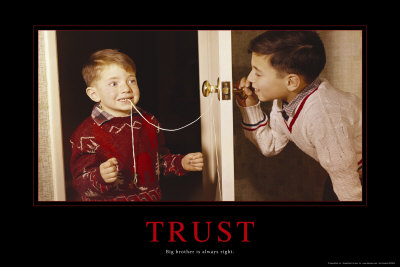
Trust?

I have to admit, after identifying Macbeth’s theme of how things are not what they appear to be, I realize that this idea can be applied to A LOT of things. Right off the top of my head, there are bucket-loads of movies that I can think of, all with this theme: Severus Snape from the Harry Potter series went above and beyond, acting all triple agent-like (Joke: Why was Snape standing in the middle of the road? Because he didn’t know which side to stand on! BWHAHAH). Gollum/Smeagol from the Lord of the Rings trilogy pretended to be like the perfect goblin/hobbit/freaky looking thingy in order to gain Frodo’s trust. And in the Matrix trilogy, we learn that everything around is all fake and that THE WORLD IS RUN BY ROBOTS!!

Clearly this theme is being overworked and leads me to play the “what if” game and to ponder many questions: If it’s highly possible that we are constantly being deceived, how can we completely trust the things around us? What if your best friend is secretly plotting your downfall? What if your pet hamster what a crazy cannibalistic creature?? What if the Santa Claus at your local mall was a phony??? What if the next chair you sit in is really an oddly shaped bomb????

I can see how it’s very easy to question everything around you, and it comes down to how you know you can trust something or someone. I think for me, experience is key. To be brief, you know if you can place your trust in something based on your experience. For example, I know that when I go to sit down at my dining room table, I’m not gonna blow up because I have sat in that seat before; I have previous knowledge and experience. The same thing goes for your best friend. If you know, and not just know about, your BFF, you will be able to know whether or not he/she is planning your demise. Now if by some strange misfortune your BFF is a really good actor/actress, and has been faking the whole relationship since you were babies, that is not your fault. That doesn’t mean you can never trust someone again; it means that your friend is a weirdo who has no conscience. For me, I can trust my close friends because I have spent time to get to know them. I have faith that my understanding of my friends is enough to give them my trust.

Another piece of advice I realized while rackin’ my noggin comes from the pointy man himself: Shakespeare. Looking at what happens in Macbeth, you’ll see how Malcolm, King Duncan’s son, tested Macduff to see if he was trustworthy. Now I don’t recommend that you go around to everyone and tell them that you are a greedy, sexually crazed, and corrupt just like Malcolm. Rather, if you want to see if you can trust someone, test his or her integrity by asking him or her to do a favor of some sort. Or  you could just simply observe that person to see how honest he or she is on a regular basis. It’s not that difficult.

So the moral of this post? Don’t be insane and paranoid and not trust anyone including your own mother. But instead, even though the theme of deceiving appearances is common, learn to trust your own instincts and experiences, and to get to know somebody before you trust that person. And now I will stop because I feel too much like Dr. Phil. Tune in next time for more advice (not really) from Dr. Aaron. =]

Jun
14

I did! I did! I did taw a paradox! (A paradox? Well sufferin’ succotash! What in tarnation is a paradox??) That’s a mighty fine question, everyone. Rather than explain what a paradox is, why don’t I give you some examples? It’s probably better that way because I’m having a brain fart and can’t explain the term properly. Some examples of a paradox would be something along the lines of this:

Nobody goes to that restaurant because it’s too crowded.

Don’t go near the water until you’ve learned how to swim.

Don’t date until you’re married!

“Fair is foul, and foul is fair.”

Do you kinda get the idea? If not, you’re in luck because my brain fart just got cleared up! A paradox is a something, like a statement, that leads to contradiction, and seems to defy logic. So in the second example, you can’t go near water until you’ve learned how to swim, right? But the only way to learn how to swim is if you’re in the water! So what are you supposed to do?!? Do you go near the water or not?!?

The reason for all this madness is just so I can have a creative way to introduce the theme of this blog, that’s all… From Shakespeare’s infamous play, Macbeth, I decided to dedicate this blog to the theme of deception in appearances. If you focus your eyeballs to the fourth example, I used this quote from the play’s very first scene (that would be Act 1, Scene 1 if you were having any trouble) as the focal point of our theme. If you are confused as what the theme is right now and are ripping/yanking/scratching your hair off your scalp, the theme is basically: THINGS ARE NOT WHAT THEY APPEAR TO BE.

A very crude example of this would be what happened to me yesterday. I came home from school and noticed that Mr. Stomach was complaining a bit. It was fairly hot outside so I go to the kitchen and realize that my mom bought popsicles. WHOOT!! They were on sale, just so you know( 40 popsicles for $4.99). Reaching my hand into the frosty freezer, I grabbed a popsicle that appeared to be tasty, hoping that the blue and red hues meant some sort of mixed berry flavor. But no. Instead of an overwhelming amount of juicy flavor, I tasted cotton candy.  COTTON CANDY! What kind of flavor is that!! NOBODY likes COTTON CANDY! And so, I fell victim to the relatable theme that, “Fair is foul, and foul is fair” …………and that cotton candy-flavored popsicles suck. 

Jun
14

Well, here we are…So this is my lame play of words on the play, Macbeth, which will be the main course for this blog. I’ll try to keep things interesting and KRAFTy (hahaha so funny, Aaron) and hopefully I can keep y’all from hitting the Backspace button. My goal for this blog? Simply just to share my thoughts and experiences with this play, and maybe provide some ooey gooey food for thought (Arghh! I told myself I wouldn’t use such a cliché line but it couldn’t be helped!) So sit back, relax, and try not to squint or anything as you read the cheesy posts of Macbeth and Cheese!

Create your own website, free on WordPress.com.Create your own website.
Start free